Oral history archive handoff
Give the archive identifiable recordings, linked interview metadata and the release or gift paperwork it specifies. Your recipient may also require matching transcripts or timecoded summaries. Follow its written instructions, connect every file to an interview ID, and record the gaps.
Check your manifest locally
For coordinators with finished interviews and a receiving archive. Paste CSV or one file path per line. Your text stays in this browser.
Required fields and ID matching
Replace these with your recipient’s fields. Interview date is checked on master rows. Duplicate IDs mean repeated master entries for the same part; shared IDs across file roles are expected.
Your discrepancy report
Starter listing: 3 files, 2 IDs with masters, 1 missing transcript.
- RMV-002: recording has no transcript row. Confirm whether your recipient requires one.
CSV checks supplied fields and links. A listing checks names and pairs. Neither reads your audio or confirms that a transcript matches it. Copying a report may include the filenames you entered.
The OHA archiving manual sets the general approach; JMU and Somerset show how actual submission packages differ.
Start with one row per file
The manifest is a file inventory. Keep the same interview ID on its recording, transcript and related files. The role column distinguishes master audio, access copy, transcript, summary, release-reference, photo and log. Use part to distinguish multi-part masters.
Columns cover identity, narrator and interviewer, interview date/place, duration, format, transcript filename, paperwork reference/status, restrictions, summary, keywords and language. source_of_value names the log, sheet row or instruction behind the value. Keep sha256 blank until calculated on the real file. Adapt the template to your recipient.
Prepare the handoff in five steps
Get the receiving archive’s written instructions
Confirm the recipient, its template, requested formats, paperwork route and transfer method. Ask which fields are mandatory and how unknown values should be recorded.
Inventory the unchanged files locally
Make a backup and generate a relative-path listing. Keep every original filename in the manifest. One row describes one file; a shared interview ID links its components.
Reconcile IDs, file roles and metadata
Check duplicate master IDs, missing pairs, blank required fields and orphans. Map each supplied value to the recipient’s field and retain its source.
Resolve questions with the project and recipient
Check transcript-to-recording correspondence locally. Refer missing paperwork and access questions to the archive. Mark unknowns and unresolved decisions explicitly.
Review the proposed folder and transfer package
Preview the filename map, run only the agreed local copy or rename steps, and calculate checksums on the resulting files. Keep the README, discrepancy report and transfer acknowledgement with the project copy.
Before moving files, ask: Which master and access formats? Which transcript version? Which paperwork is transferred separately? How should closed material be identified? Who checks the inventory and checksums on arrival? The Oral History Society workflow places documentation and archiving alongside the recording work.
Deposit requirements compared
11 sources, checked 10 November 2026. This is a comparison of published instructions and guidance, not a list of repositories available to take your project. “Not specified” means the reviewed source does not state it. It does not mean the institution has no rule. Your recipient’s current written instructions govern your package.
Read the source type before copying a rule. The requirements CSV includes source dates, named forms/fields, filename rules, technical instructions and unresolved gaps. Our compilation and template are CC BY 4.0; linked institutions retain their own material.
| Institution / source | Named files / forms | Named metadata | Names and transfer instructions | Unspecified here |
|---|---|---|---|---|
| OHA archiving manualGeneral best practice Source date: 2019-10 Checked: 2026-11-10 | Media; transcripts; photographs; digital items; custody paperwork (examples: deeds of gift, releases, letters of transmittal) | interviewer; narrator; date; place; keywords; summary; size; format; compression; restrictions | Unique interview/component numbering or naming; no literal pattern Inventory incoming objects and corresponding checksums; redundant copies | No universal mandatory template or filename syntax |
| Library of Congress: Veterans History ProjectProgram submission requirements Source date: 2025-12-04 Checked: 2026-11-10 | Biographical Data Form; Veteran’s Release Form; Interviewer’s/Volunteer’s Release Form (interview); Audio and Video Recording Log (recorded interview); Photograph Log (photos); Manuscript Data Sheet (written material) | Name of Contributor/Interviewer; Name of Veteran; Birth Date; Estimated length of recording (in minutes); Date of recording; Location of recording (City, State); Digital File type; Minute Mark; Topics | Not specified in these forms Log names WAV, MPEG2/MPG, MOV, MPEG4/MP4; separate Media and Formats Standards | No filename pattern or checksum algorithm in the reviewed forms |
| Duke University ArchivesRepository toolkit Source date: Not stated Checked: 2026-11-10 | Recording; signed Release Form; Basic Metadata Form | Interviewee’s full name and date of birth; Interviewer’s full name; Date of the interview; Location of the interview (city, state, country); Setting of the interview (home, workplace, public space); Duration of the interview in minutes and seconds; Abstract of the interview | [interviewee last name][interviewee first name]_[YYYYMMDD]; example smithjane_20160413.wav WAV; preserve original recording | No checksum or inventory schema on this page; transcript not listed as a submission condition |
| James Madison University Special CollectionsRepository submission requirements Source date: Not stated Checked: 2026-11-10 | JMU Special Collections Oral History Gift Agreement (both parties); finalized matching transcripts; audio/video; project description; biographical sketches | Date and location; project description ≤500 words; interviewee sketch ≤200 words; interviewer sketch ≤200 words | Not specified Recipient specifies recording format; transcripts must match recordings without significant edits | No filename pattern, checksum method or manifest columns on this page |
| Somerset Heritage Centre / South West Heritage TrustRepository deposit guidelines Source date: 2024 (file title) Checked: 2026-11-10 | Digital recording; timecoded recording summary; signed recording licences; recording data sheet; sensitivity review; recording schedule and list of documents. Full transcript optional | Appendix B: Ref. no; WAV file name; Collection title; Interviewee’s surname, forename(s), Title, Preferred name; Occupation; Gender; Date and place of birth; Date(s) of recording(s) and associated track numbers; Location of interview; Name of interviewer; Recording equipment; Total no of tracks; Recording format; Mono or stereo; Total duration (HH:MM:SS); Additional material deposited; Copyright/clearance; Summary or transcript completed; Date completed; Sensitivity review completed and by whom; Redactions or closures, with length of closure; Interviewer’s comments. Appendix D: Recording Number; Details of Recording; Date of Recording; Duration of Recording; Interviewer; Licence; Transcript, summary or both | Unique number + surname: 001.SMITH; same number on summaries/transcripts WAV; memory stick/portable drive; named subfolders; original signed paper licences; sensitivity review preferably Excel | No checksum algorithm or transcript document extension specified |
| University of Illinois: Voices of IllinoisProject recommendations Source date: Not stated Checked: 2026-11-10 | Metadata spreadsheet with project files and other documentation (recommended) | File name; department name; project name; title; interviewee name; interviewer name (if appropriate); location; date; file type; file size | Develop conventions; no literal pattern Text examples DOCX/PDF; audio examples WAV/MP3; video MPEG/MOV; these are examples | No mandatory deposit schema or checksum instruction on this page |
| Oral History Society (UK)General workflow guidance Source date: Not stated Checked: 2026-11-10 | Project Information Sheet; Interview Participation Agreement; Interview Recording Agreement; interview data sheet; Interview content summary and Sensitivity review form; project audit sheet | Completion/in progress/transferred status; closures on audit sheet, content summary and data sheet | Decide a system; redacted version uses a different filename Create checksums; backup audio; compressed listening copies such as MP3/MP4; transcript if required | No checksum algorithm, literal filename pattern or full data-sheet fields on this page |
| Oral History VictoriaGeneral documentation guidance Source date: Not stated Checked: 2026-11-10 | Post-interview summary, transcript, timed summary or overview discussed as options | Interviewer; Interviewee; Translator; Description; Subject key words; Date; Place; Number of files; transcript/timed summary/overview available; Copyright holder; Access conditions; resource type; Format; Language | Example: Jane Smith, Smith Family Oral History Project, 1 January 2025.wav WAV for archival storage; MP3 for sharing; at least two storage locations suggested | No deposit mandate, checksum algorithm or stable ID syntax |
| Baylor Institute for Oral History: grant criteriaGrant-specific deposit conditions Source date: Not stated Checked: 2026-11-10 | Recordings; transcripts; Institute’s Deed of Gift; brief report for Charlton award | No per-interview deposit field list in reviewed grant criteria | Not specified Equipment/media must conform to Institute standards; detailed standard not on this page | No general external-deposit checklist, manifest or checksum syntax |
| University of Kentucky: Louie B. Nunn CenterRepository forms / proposal route Source date: Deed v3: 2025-11-05 Checked: 2026-11-10 | Oral History Project Proposal Form; Interview Release/Deed of Gift Form | Deed: INTERVIEWEE; INTERVIEWER; recorded on (Date); signatures; addresses; email; phone; temporary access restrictions; restriction end-date/condition | Not specified in resources page or linked deed Recorded interview and designated associated photographs/moving images described in deed | No full technical handoff specification or checksum instructions in these two sources |
| Wisconsin Veterans MuseumProgram donation requirements Source date: Not stated Checked: 2026-11-10 | Wisconsin Veterans Museum Deed of Gift signed by narrator and interviewer; written summary; interview information sheet; preservation master copy | The Q&A does not enumerate the information-sheet fields | Not specified in donation Q&A (catalogue citation is not a donor naming rule) Preservation master copy; format not stated in Q&A | No information-sheet schema, filename rule or checksum procedure on this page |
For VHP, read the actual Audio and Video Recording Log and Media and Formats Standards alongside the paperwork FAQ. The Nunn row also uses its linked Deed of Gift, v3, updated 5 November 2025. Those additional documents belong to their parent row; they are not counted as extra sources.
Field crosswalk: explicit mentions in this set
Interview date appears in 8 of these 11 sources; narrator and interviewer each appear in 7. Only 2 explicitly call for a unique interview identifier. These are counts of explicit field concepts across a mixed source set, including general guidance. They measure neither institutional popularity nor mandatory fields at every archive.
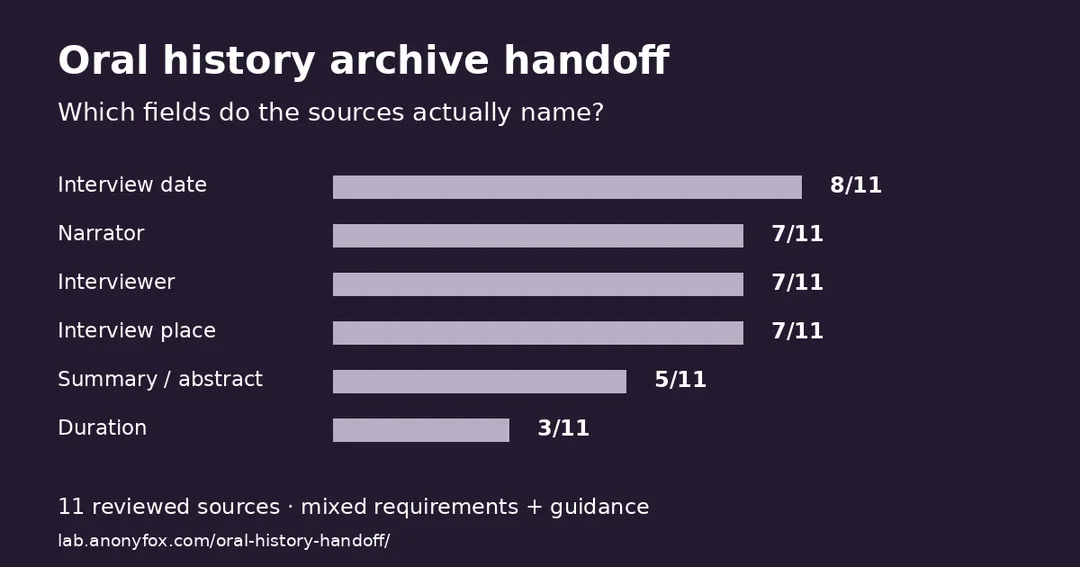
| Template field | Sources / 11 | Evidence rows |
|---|---|---|
| Stable interview ID | 2/11 | OHA, SOMERSET |
| Filename as a listed metadata field | 2/11 | SOMERSET, ILLINOIS |
| Narrator / interviewee | 7/11 | OHA, VHP, DUKE, SOMERSET, ILLINOIS, OHV, NUNN |
| Interviewer / recorder | 7/11 | OHA, VHP, DUKE, SOMERSET, ILLINOIS, OHV, NUNN |
| Interview date | 8/11 | OHA, VHP, DUKE, JMU, SOMERSET, ILLINOIS, OHV, NUNN |
| Interview place | 7/11 | OHA, VHP, DUKE, JMU, SOMERSET, ILLINOIS, OHV |
| Duration / length | 3/11 | VHP, DUKE, SOMERSET |
| Format as a metadata field | 5/11 | OHA, VHP, SOMERSET, ILLINOIS, OHV |
| File size | 2/11 | OHA, ILLINOIS |
| Transcript filename as a named field | 0/11 | |
| Release-reference as a named field | 0/11 | |
| Signed licence / release exists status | 1/11 | SOMERSET |
| Restrictions / access conditions | 5/11 | OHA, SOMERSET, OHS, OHV, NUNN |
| Summary / abstract / description | 5/11 | OHA, DUKE, SOMERSET, OHV, WISCONSIN |
| Keywords | 2/11 | OHA, OHV |
| Transcript / summary availability status | 2/11 | SOMERSET, OHV |
| Language | 1/11 | OHV |
How we counted fields
The eleven rows above form the denominator. A field counts only when named in the page or the specifically linked form reviewed for that row. We normalize “interviewee” to narrator, “recorder” to interviewer, and “length” to duration. A timed topic log is not an abstract, so VHP’s topic log is not counted as summary. A narrative biography is not counted as a separate narrator-name field. Somerset’s Appendix B explicitly names Location of interview, so it contributes to interview place. Its separate residence information is not used for that vote. Summary counts a named summary/abstract/description field or an explicitly requested written summary document; Wisconsin contributes through its required summary.
A form’s existence is not a release-status metadata field. A format instruction is not automatically a format metadata field; Duke’s WAV rule therefore does not add a vote to that row. Filename patterns count as naming instructions, while the filename metadata count requires a listed field. Transcript filename and release-reference are useful reconciliation columns, but none of the reviewed field lists explicitly names them as such: 0/11 for each under this strict coding. The template also adds role, part, source_of_value and sha256 for working control; those are our design choices.
Counts are a hand-coded compilation, not a survey. You can audit each positive vote in the crosswalk CSV and the original sources. Empty or unmentioned cells are not evidence of absence elsewhere in an institution’s workflow.
Worked example: Riverside Mill Voices
This fictional project has ten interviews. Its folder contains 21 file entries and five planted problems. The example uses an ID-first convention chosen for this page; it is not an institution’s required pattern.
Before: the working folder
RMV-001_master.wav
RMV-001_transcript.txt
RMV-002_master.wav
RMV-002_transcript.txt
RMV-003_master.wav
RMV-003_duplicate.wav
RMV-003_transcript.txt
session004.wav
RMV-004_transcript.txt
RMV-005_master.wav
RMV-005_transcript.txt
RMV-006_master.wav
RMV-006_transcript.txt
RMV-007_master.wav
RMV-008_master.wav
RMV-008_transcript.txt
RMV-009_master.wav
RMV-009_transcript.txt
RMV-010_master.wav
RMV-010_transcript.txt
RMV-999_photo.jpg
Two master entries use RMV-003, and the photo belongs to no listed interview. A file listing alone cannot expose the missing interview date.
After: a reviewable transfer plan
The inventory keeps every original name and adds a proposed name plus review status. It leaves the missing date unresolved. The second RMV-003 master and the photograph go into a review queue until the project can identify them.
Riverside-Mill-Voices/
  01-masters/       # approved recording copies
  02-transcripts/   # matched, reviewed text
  03-context/       # identified photos and logs
  04-metadata/      # manifest, filename map, README
  review-hold/      # unresolved items, not final deposit
Confirm this folder plan with the recipient. Signed releases follow its separate agreed route.
Download the reconciled inventory · Read the discrepancy report| Finding | Original → proposal / recorded state | Next action and evidence |
|---|---|---|
| Duplicate ID / part | RMV-003_master.wav + RMV-003_duplicate.wav → hold second entry | Compare locally and consult the project log. Keep both originals; it could be another part. |
| Missing transcript | RMV-007 → transcript absent | Ask the recipient whether a transcript is required or a timecoded summary is sufficient. |
| Filename mismatch | session004.wav → RMV-004_master.wav (proposed) | Check identity against the supplied project log before making a copy under the proposed name. |
| Orphan photograph | RMV-999_photo.jpg → unlinked / review hold | Ask the project what it depicts; do not assign it from proximity in the folder. |
| Missing date | RMV-008_master.wav → date unknown | Ask for a contemporaneous log. Do not substitute the file modification date. |
Run the same CSV in the checker to reproduce all five findings. The plain listing demonstrates the smaller set of checks possible without metadata. The after CSV is a documented reconciliation state, with outstanding actions visible.
Choose IDs before changing filenames
Use the recipient’s required syntax first. Duke’s example is smithjane_20160413.wav. Somerset’s is 001.SMITH, with the same unique number on the related summary or transcript. Their rules are different; neither is a universal oral-history standard.
When the recipient leaves the convention to you, a stable project prefix and zero-padded number can work: RMV-004. Add a role and, where needed, a part: RMV-004_master_p01.wav and RMV-004_transcript_p01.txt. Keep names stable when descriptive metadata changes. Store dates as YYYY-MM-DD and document unknowns in the report.
Keep the original path, proposed path, ID, role and source of the assignment together. A compiled wiki uses stable IDs and a manifest to keep generated material tied to its source; an archive handoff needs the same traceable relationship between originals and proposed names.
Use the recipient’s formats
Duke specifies WAV. Somerset asks for WAV and electronic summaries/transcripts. Illinois lists DOCX and PDF as text examples, and WAV/MP3 as audio examples; those examples are not a compulsory conversion policy. VHP’s format sheet separates original unedited materials from formats for new content, including WAV audio and TXT/RTF text.
Keep original recordings. Ask about BWF, sample rate, bit depth and transcript format only where relevant to your files and the recipient’s instructions. None of this page’s reviewed deposit field lists establishes a universal PDF/A rule. A new filename or extension alone does not change a file’s format.
Make the inventory on your own computer
Run these from the collection folder. Reports are written one level above it, so they are not included in their own inventory. The commands read files and leave the originals in place. Review paths before sharing a listing; filenames themselves can contain personal information. Use one path per line with conventional filenames; embedded line breaks in filenames need a different export.
macOS / Linux
# Run from the collection folder; outputs go one level above it.
find . -type f -print > ../oral-history-files.txt
find . -type f -exec shasum -a 256 {} + > ../oral-history-sha256.txt
# Linux alternative if shasum is unavailable:
# find . -type f -exec sha256sum {} + > ../oral-history-sha256.txt
Windows PowerShell
# Run in the collection folder. Reports go outside it.
$collectionRoot = (Get-Location).Path
$files = Get-ChildItem -File -Recurse
$files | ForEach-Object {
  $_.FullName.Substring($collectionRoot.Length + 1)
} | Set-Content -Encoding utf8 ../oral-history-files.txt
$files | Get-FileHash -Algorithm SHA256 |
  Select-Object Path, Algorithm, Hash |
  Export-Csv -NoTypeInformation -Encoding utf8 ../oral-history-sha256.csv
Pick the resulting oral-history-files.txt in the checker. A SHA-256 checksum is calculated from file content, so the browser checker cannot calculate it from a filename listing. Generate hashes after any agreed file conversion, and ask the recipient to verify the same files after transfer. Keep the algorithm, run date and path map with the report.
Keep the project copy and paperwork references
Keep your raw recordings, original metadata, backups and signed releases in the project’s care under its agreed arrangements. Your archive may require originals or copies of the paperwork directly; follow that separate route. For reconciliation, record the local register reference and supplied status. Decisions about permission, ownership, custody and access stay with the project and the receiving archive.
If the collection began as family history, German Records Desk helps locate German civil or residence records. Those documents and recorded memories have different provenance; label each source rather than merging their claims.
Handoff reconciliation
Give your receiving archive a package it can review, with every proposed filename and unresolved question accounted for.
One project, one receiving archive’s written instructions, up to 20 interview IDs and 200 file entries. Delivery within 3 working days of complete inputs. One factual correction round.
What arrives
- XLSX + CSV inventory with original‑to‑proposed filenames, stable interview IDs and file-role links.
- Missing, duplicate and orphan flags; mapping of your supplied metadata to the recipient’s fields; a source-of-each-value column.
- A discrepancy report and ready‑to‑review folder plan + README.
- A local rename/copy recipe that you preview and run yourself, plus a local checksum script. Checksum output is included only if you ran it.
After payment, reply to the email
You get a confirmation email. Reply with (a) a file listing or manifest generated locally, (b) your existing metadata spreadsheet or logs, and (c) the archive’s written deposit instructions or template. Raw recordings and signed releases stay with you; we never need the audio.
Working days are Monday to Friday excluding public holidays in Hamburg. The three-day delivery window starts when all inputs are complete.
The job we take on
We reconcile the files and supplied metadata against the recipient’s instructions. Transcription, writing summaries, rights/consent/copyright/legal custody/access decisions, choosing a repository, uploading, and any guarantee the archive accepts the deposit are outside the service. If the job cannot fit the scope, we say so and refund instead of quietly changing it.
€149 · No VAT is charged under § 19 UStG (German small business regulation).
Buy handoff reconciliation · €149Business buyers can add a tax ID at checkout. Stripe provides the invoice.
Questions about inputs? [email protected]. Keep the after-payment preparation steps for reference.
Common handoff mistakes
- Counting the transcript as proof that the audio matches
- The Science History Institute describes synchronization problems after transcript edits. Check the corresponding interview and version locally. The filename checker cannot listen.
- Treating a signed release as a resolved question
- Practitioners report contradictory selections on historic forms; David Amel Olson’s 2024 SAA presentation documents missing and problematic releases. Record the reference and refer the question to the recipient.
- Changing names without preserving a map
- The Oral History as Data documentation calls filename/object-ID mismatch a common problem in that system. Keep the original path alongside any proposal, so a reviewer can trace the file.
- Filling blanks from guesswork
- File modification dates may reflect copying or editing. A missing interview date stays unknown until a project source establishes it. Each supplied value gets its source reference.
Questions before the transfer
What does an archive need for an oral-history deposit?
Start with its written instructions: recordings, linked descriptive metadata and the specified release or gift paperwork. Some recipients also require matching transcripts, summaries, data sheets or sensitivity reviews. Use the requirements comparison to prepare questions for your recipient.
Does every interview need a transcript?
Follow the recipient’s instructions. JMU requires finalized matching transcripts. Somerset requires a timecoded summary and makes a full transcript optional. The checker flags an absent transcript as a review task, not an automatic failed deposit.
Can I use a file listing instead of a metadata spreadsheet?
Yes for an initial local check. Paste one relative path per line, including subfolders. A listing can reveal name and pairing problems; it cannot establish interview dates, narrator identity, release status or whether a transcript matches the recording.
Why is an interview ID repeated in the template?
The manifest has one row per file. A master, transcript and photograph can share an interview ID. The checker flags multiple master rows with the same ID and part number; use distinct part numbers for a multi-part recording.
Can this checker verify signed releases or transcript accuracy?
It checks supplied names and metadata. The project checks that the transcript belongs to the recording and records paperwork references. The receiving archive resolves consent, access and rights questions.
Should I convert all existing audio to WAV?
Ask the recipient first and keep the original. Duke specifies WAV; VHP asks for unedited materials in their original format and lists formats for new content separately. Converting an MP3 into WAV cannot restore information lost during compression.
What do I send after paying €149?
Check your inbox for the confirmation email and reply with your locally generated file listing or manifest, existing metadata spreadsheet or logs, and the receiving archive’s written instructions or template. Keep the recordings and signed consent documents locally. A file listing supplies the information needed for reconciliation.
When will I receive the reconciliation?
Within 3 working days of complete inputs, with one factual correction round. The offer defines working days. A job that exceeds the stated scope is refunded.
Which checksum does the deposit actually name?
The deposit comparison often records a call for checksums without naming an algorithm. Two of the eleven sources reviewed here mention checksums at all: the OHA archiving manual and the Oral History Society workflow. Neither names SHA-256 or SHA-512 on the pages we compared. The transferable package format that does name algorithms is BagIt 1.0, published as RFC 8493.
RFC 8493 says bag creation and validation tools MUST support SHA-256 and SHA-512, and they SHOULD enable SHA-512 by default when creating new bags. MD5 and SHA-1 remain for reading older bags. A complete bag has every required element and every file listed in every payload and tag manifest; for BagIt 1.0 every payload file MUST also appear in every payload manifest. A valid bag is a complete bag whose checksums have all been verified against the corresponding files.
| Convention | Checksum rule | Complete or valid package | Source |
|---|---|---|---|
| BagIt 1.0 (RFC 8493) | MUST support SHA-256 and SHA-512; SHOULD default to SHA-512 for new bags | Complete: every required element and every listed file is present; valid: complete, and every checksum matches | RFC 8493, §§ 2.4 and 3 |
| OHA archiving manual | Inventory incoming objects and corresponding checksums; no algorithm named | No BagIt layout or completeness test on the compared page | OHA manual (2019) |
| Oral History Society (UK) | Create checksums; no algorithm named | No BagIt layout or manifest filename on the compared page | Oral History Society workflow |
| This comparison as a set | 2 of 11 sources mention checksums; 0 of 11 name SHA-256 or SHA-512 | A call to create checksums is not a transferable package profile | Compiled from the deposit-requirements CSV |
Download the checksum and package comparison as CSV. If a coding agent will pack the transfer, put the recipient’s current written rules in an AGENTS.md file and check that file with the AGENTS.md checker.
Sources and reusable data
The comparison cites each source beside its row. The OHA manual (2019) supplies the general archival framework. The Library of Congress Folklife and Fieldwork, fourth edition (2016) puts archive planning alongside fieldwork and metadata. Download the requirements data or read the full Markdown edition. Updated 10 November 2026.