Anonyfox / Lab

Vibe coding production checklist

Is your vibe-coded app ready for production? Check five launch blockers first: broken access control, secrets in browser code, duplicate payment effects, concurrent writes that lose data, and recovery you have never tested. Use the 50 checks below to record evidence and choose what to fix next.

For apps built with Cursor, Claude Code, Codex, Lovable, Bolt, Replit or v0. Updated 10 November 2026.

0 of 50 applicable checks verified

Your verification progress

0 / 50

Applicable checks you have verified. This is a completion count, not a safety rating.

Top 3 checks to verify first

  1. Access: Every sensitive route authorizes on the server.
  2. Tenancy: Tenant ownership covers reads, writes and deletes.
  3. Database: Supabase RLS or Firebase rules restrict each user.

Unchecked items use default severity × likelihood × blast radius estimates. They are review priorities, not detected defects.

Progress saves in this browser.

Auth & access

Verify: Trace registered middleware; call the route as a normal user and while logged out.

Verify: Use two tenant accounts; cross-tenant requests must fail without changing state.

Verify: Inspect deployed rules and test anonymous, owner and other-user access.

Verify: Test expiry, logout and a repeated reset link against an isolated environment.

Verify: Change a body/header role field; it must not grant privileges.

Secrets & bundles

Verify: Inspect the built JavaScript for secret references; publishable keys are different.

Verify: Review each public variable and its value class without copying credentials.

Verify: Check ignore rules and tracked filenames; review history separately if exposure is suspected.

Verify: Confirm rotation with the provider and remove every client or logged copy.

Validation & injection

Verify: Send wrong types, unknown fields and oversized values; expect controlled rejection.

Verify: Trace untrusted input into SQL; check that values cannot change query structure.

Verify: Trace raw HTML sinks to trusted or maintained sanitization paths.

Verify: Check content/size limits, storage permissions and private-network URL rejection.

Payments & webhooks

Verify: Alter a signed test payload; verify rejection before fulfillment writes.

Verify: Deliver the same event concurrently and after restart; expect one business effect.

Verify: Retry the same operation after a simulated connection loss; expect one charge.

Verify: Change client price/customer fields; they must not control fulfillment.

Verify: Run test-mode lifecycle events and check persisted entitlement state.

Data integrity

Verify: Fail each step in staging; earlier dependent writes must roll back.

Verify: Race two stock, balance or quota updates; neither may overdraw the resource.

Verify: Attempt duplicate and orphan writes directly in an isolated database.

Verify: Crash between state change and dispatch; restart must converge without duplication.

Queries & performance

Verify: Seed representative data; verify stable bounds and cursor behavior.

Verify: Compare query count for 1, 10 and 100 entities; inspect batching.

Verify: Review EXPLAIN plans on staging data near the expected production volume.

Verify: Submit a burst and observe queue depth, worker count and response budgets.

Resilience

Verify: Simulate a dependency that never replies; requests must release workers on time.

Verify: Force transient errors; count attempts and check delays against the request budget.

Verify: Verify a circuit breaker or equivalent concurrency cap prevents worker exhaustion.

Verify: Kill a worker around acknowledgment; work must complete once or enter a failed-job queue.

Errors & observability

Verify: Break a staging write; the UI must show failure and permit a safe retry.

Verify: Trigger representative failures and inspect redacted structured logs.

Verify: Send a synthetic alert and confirm delivery and acknowledgment.

Verify: Simulate a failed dependency; readiness should fail without exposing internals.

Deploy & recovery

Verify: Apply migrations from zero in staging and exercise a core workflow.

Verify: Restore to an isolated environment; record recovered data and elapsed time.

Verify: Inspect environment bindings and payment modes without exposing values.

Verify: Rehearse the documented rollback after a representative migration.

Rate limits & AI abuse

Verify: Burst through the real ingress; verify 429 responses and per-user fairness.

Verify: Race requests near the budget; total reservations/spend must stay within the cap.

Verify: Exercise repeated expensive requests; verify bounded work and recovery.

Dependencies & supply chain

Verify: Review names, lockfile provenance and install hooks without executing them.

Verify: Run an authorized advisory scan separately; evaluate reachability and supported fixes.

Verify: Inspect immutable action refs, fork triggers and job permissions.

Tests that matter

Verify: Check assertions against real persistence and authorization boundaries.

Verify: Inspect duplicate-event, failed-write and race test scenarios and expected state.

Verify: Check focused/skipped tests and ignored failure exits in the workflow.

AI-specific review

Verify: Check supported signatures/types or official source for critical integration calls.

Verify: Trace TODOs, stub returns and mock success states reached by real users.

Verify: Read oversized modules and duplicated workflows; compare their invariants.

Download all 50 checks as Markdown

Tick a check after verification. Use “Not applicable” only when the feature or risk does not apply to your app. No sign-up. Copy includes your unchecked priorities and N/A items.

Worked example: RecallIQ at commit af423c9

181 scanner candidates became 11 confirmed candidates, 166 dropped matches and 4 checks needing runtime evidence.

RecallIQ is an MIT-licensed React and Supabase app whose README says “Built with Lovable.” This source review is pinned to af423c91f366551b001e4e6f76cda3039b881488, dated 12 July 2025. Reviewed 10 November 2026. The app was never run and its live deployment was not tested.

Rules run
49
Raw candidates
181
Confirmed candidates
11
Dropped candidates
166
Withheld issues
4

The 11 confirmed candidates group into 3 issues. Manual review adds 13 issues: 9 published and 4 withheld. That gives 16 confirmed issues, with 12 published below. Candidate counts and issue counts are different units. 4 candidates still need runtime evidence.

1 access-control finding withheld for private disclosure to the author (Critical). 2 access-control findings withheld for private disclosure to the author (High). 1 payment finding withheld for private disclosure to the author (High). Details remain private; the author has not been contacted.

  1. High · Memory-derived AI content is copied into function logs24 / 64
    24 / 64

    Errors & observability · severity 2 × likelihood 4 × blast radius 3

    supabase/functions/ai-enhance-memory/index.ts:111

    The enhancement handler logs the raw model response and parsed content, plus a description fragment. Search and insights handlers also log query or model output. Personal memory content can therefore be duplicated into operational logs with separate access and retention settings. This is a logging exposure, not a demonstrated public read path.

    Fix and verification

    High confidence: the raw-response log call is unconditional on the successful provider path; actual log retention and staff access are unknown.

    Fix: Remove content-bearing logs. Record request IDs, stage, elapsed time and provider status instead. Set retention and restrict access to any existing logs containing memory content.

    Verify: Submit a synthetic memory containing a unique harmless marker in staging. Successful and failed requests produce useful diagnostics without that marker in logs. Not run.

  2. High · A failed memory save keeps the credit deduction18 / 64
    18 / 64

    Data integrity · severity 3 × likelihood 3 × blast radius 2

    src/hooks/useMemoriesWithCredits.ts:18

    AddMemory calls addMemoryWithCredits. The hook awaits deductCredits before attempting the memory insert in a separate request. A failed insert enters a catch that tells the user credits were deducted; there is no compensation. Retrying can charge again without creating the first memory.

    Fix and verification

    High confidence: the debit and memory insert are separate awaited calls, and the failure branch explicitly retains the debit.

    Fix: Combine the database insert and credit ledger mutation into one server transaction with an operation ID. Include attachment completion or a durable recovery state where needed.

    Verify: Fail the memory insert after an eligible debit. Persisted credits remain unchanged and a retry saves exactly one memory with one debit. Not run.

  3. High · AI work has no application spend reservation18 / 64
    18 / 64

    Rate limits & abuse · severity 2 × likelihood 3 × blast radius 3

    supabase/functions/ai-generate-insights/index.ts:17

    The insights handler maps the supplied memory collection into a prompt and calls the provider. Output max_tokens is set, but input collection size, simultaneous work and total application spend have no reservation or budget in this code path. Even ordinary repeated use can consume a shared provider quota. Gateway/provider controls may reduce exposure.

    Fix and verification

    High confidence that code-local controls are absent; external quotas and current pricing are unknown. This is not a claim about unauthenticated reachability.

    Fix: Bound request bytes and memory count. Reserve per-user and global provider budget atomically before work; release or settle the reservation after completion.

    Verify: In staging, issue concurrent eligible requests near a small test budget. Total reserved/spent work stays within the cap and excess work is rejected before provider calls. Not run.

  4. Medium · Nine external fetches have no cancellation deadline12 / 64
    12 / 64

    Resilience · severity 2 × likelihood 3 × blast radius 2

    supabase/functions/ai-generate-insights/index.ts:50

    The scanner matched nine fetch calls across chat, order creation, OCR and audio processing. Each handler was read: none passes an abort signal. A hung upstream occupies the handler until an external platform limit; maxAttempts in transcription does not bound a single pending fetch.

    Fix and verification

    High confidence: all nine matched fetch options were inspected; platform shutdown limits are external and do not supply a controlled cancellation path.

    Fix: Set per-attempt AbortSignal deadlines within a total request budget. Handle cancellation and retry only safe transient operations within that budget.

    Verify: Use a staging upstream that accepts a connection and never replies. Every path exits inside its declared budget and records a retryable failure. Not run.

  5. Medium · The memories list has no pagination12 / 64
    12 / 64

    Queries & performance · severity 2 × likelihood 3 × blast radius 2

    src/hooks/useMemories.ts:34

    fetchMemories requests every visible row and column, ordered by date, without a cursor or range. Dashboard filters and search consume the full client array. Large histories increase transfer/render work; a configured API row ceiling can silently make that array incomplete. Owner RLS exists; this is a collection-size issue.

    Fix and verification

    High confidence: the query and its full-array callers lack pagination; actual row counts and the configured API ceiling are unknown.

    Fix: Fetch bounded pages with a stable date/id cursor, select only display fields, and move collection-wide search/filtering to bounded server queries.

    Verify: Load a fixture larger than the API row ceiling. All pages remain reachable and the first screen fetches a bounded payload. Not run.

  6. Medium · Transcription waits and polls inside the request12 / 64
    12 / 64

    Resilience · severity 2 × likelihood 3 × blast radius 2

    supabase/functions/process-audio-transcription/index.ts:81

    The handler retains the upload/transcription workflow while polling up to 60 times with five-second sleeps, plus fetch duration. A long job can outlast the request/runtime and leave provider work running without a durable local continuation.

    Fix and verification

    High confidence: the polling loop and sleeps execute inside the request; the deployed runtime limit and provider job durations are unknown.

    Fix: Persist the provider job ID and attachment status, return a job response, and use a bounded retryable worker or authenticated completion callback.

    Verify: Submit a slow staging job and restart the worker. The request returns promptly and one durable job eventually reaches completed or failed. Not run.

  7. Medium · The AI search error handler uses out-of-scope variables12 / 64
    12 / 64

    Errors & observability · severity 2 × likelihood 3 × blast radius 2

    supabase/functions/ai-search-memories/index.ts:130

    query and memories are const bindings inside try. The sibling catch references them when the upstream fails. Those bindings are outside the catch scope, so the intended fallback throws instead of returning its JSON error response.

    Fix and verification

    High confidence: the try-block const bindings are lexically unavailable to its sibling catch; the target TypeScript was not compiled.

    Fix: Keep validated fallback inputs in outer scope, or return a controlled error without fallback. Validate shape before invoking any fallback.

    Verify: Force a provider 503 and malformed request separately. The handler returns controlled JSON with the intended status; no secondary ReferenceError occurs. Not run.

  8. Medium · Processing failure tries to consume the body twice12 / 64
    12 / 64

    Errors & observability · severity 2 × likelihood 3 × blast radius 2

    supabase/functions/process-image-ocr/index.ts:122

    OCR already consumed req.json() at line 18. Its catch tries req.json() again before updating failed status; the consumed stream rejects and the inner catch only logs. Audio transcription repeats this pattern at line 157. Attachments can remain pending after processing fails.

    Fix and verification

    High confidence: both request bodies are consumed before the recovery branch attempts to read them again.

    Fix: Parse once and retain the validated attachment ID outside try. Update failure state using that value; handle the update result and define a retry path.

    Verify: Make OCR and audio providers fail after body parsing. The attachment reaches failed once, the client receives an error, and retry can proceed. Not run.

  9. Medium · A local search fallback is reported as paid AI success12 / 64
    12 / 64

    Errors & observability · severity 2 × likelihood 3 × blast radius 2

    src/hooks/useAISearchWithCredits.ts:30

    The credit hook calls aiService.searchMemories after deducting credits. That service catches an invocation failure at src/lib/ai.ts:95 and resolves basic text results. The hook therefore shows AI Search successful and retains the debit although AI processing failed.

    Fix and verification

    High confidence: the client service resolves its local fallback while the caller treats every resolved result as AI success.

    Fix: Return a discriminated result for AI versus local fallback. Settle the AI charge only on the paid success path, with durable compensation for failed requests.

    Verify: Fail the edge invocation. The UI explicitly labels local search, shows no AI‑success toast, and persisted AI credits are unchanged. Not run.

  10. Medium · The payment demo does not supply automated regression coverage9 / 64
    9 / 64

    Tests that matter · severity 1 × likelihood 3 × blast radius 3

    package.json:6

    The package scripts have build/lint/preview but no test command. The sole tests/razorpay-test.html is an interactive form that invokes functions and displays results; it has no executable assertions for persisted state, failure recovery or repeated delivery. Its existence does not establish payment/auth test coverage.

    Fix and verification

    High confidence in the checked-in coverage gap; private or external CI suites may exist and were not available.

    Fix: Add assertion-based integration tests for two-user access, failed writes, payment retries, concurrent credit changes and migration replay. Keep credentials and live services out of fixtures.

    Verify: Run the new suite against disposable staging state; deliberately remove a guard in an authorized test branch and confirm the corresponding regression fails. Not run.

  11. Medium · Search starts one attachment query per memory8 / 64
    8 / 64

    Queries & performance · severity 2 × likelihood 4 × blast radius 1

    src/lib/ai.ts:61

    searchMemories uses Promise.all over the full memory array and executes an attachment query for each item before the AI call. Query count and concurrent requests grow linearly with history size. Errors returned as SDK result.error are also not examined in this loop.

    Fix and verification

    High confidence: one SDK query is created per mapped memory; latency and rate-limit behavior need representative load data.

    Fix: Batch attachment retrieval for a bounded page of owned memory IDs, group results locally, and inspect returned errors. Bound concurrency for any remaining fan-out.

    Verify: Record database request counts for 1, 10 and 100 memories. Retrieval uses a bounded number of batched requests rather than one per memory. Not run.

  12. Low · Environment files are not explicitly ignored3 / 64
    3 / 64

    Secrets & client bundles · severity 1 × likelihood 3 × blast radius 1

    .gitignore:1

    The ignore file excludes *.local, build outputs and logs. It does not exclude .env or .env.production. A future local environment file with credentials could be staged accidentally. This finding does not claim a credential was leaked.

    Fix and verification

    High confidence: the complete ignore file was read; tracked credential exposure and Git history were not inspected.

    Fix: Ignore .env and .env.* while allowing a value-free example file. Check tracked filenames separately and rotate only if an authorized credential review confirms exposure.

    Verify: Create dummy environment filenames in a temporary checkout; git check-ignore identifies each intended private file while a sanitized example remains trackable. Not run.

Three matches we dropped

Ranks use severity × likelihood × blast radius, each scored from 1–4. The list excludes withheld issues. Provider and gateway settings remain unknown. Every verification step is proposed; none was run against the app.

Download the RecallIQ review · Markdown
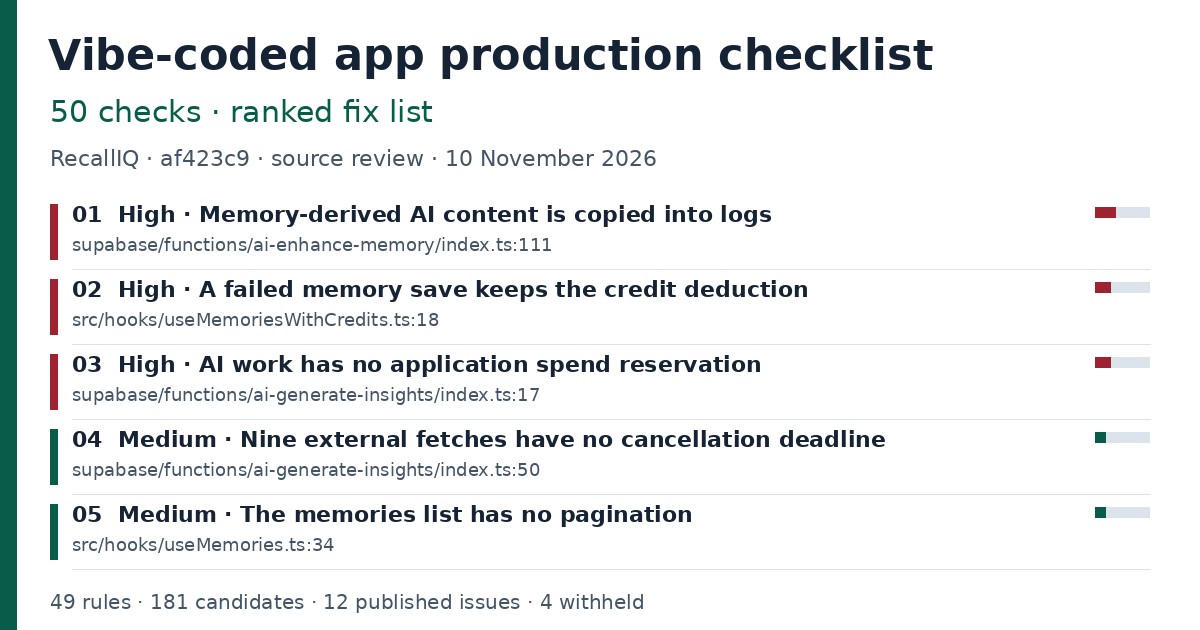
RecallIQ ranked fix list: private-content logging, failed credit operations, AI cost caps and external request deadlines
Published findings from the pinned source review. The full report records assumptions, fixes and proposed verification steps.

One event record can still mean two grants.

The pack’s local SQLite example gives two workers the same event.

Both workers read “not processed.” Both write a grant. Only then do they insert the event ID. The event table has a unique key, so one insert is ignored. There is one event row. There are two grants.

The mistake is the order of the writes: a unique event record cannot protect an effect that has already happened.

In the corrected example, a write transaction inserts the event guard first. The worker that wins writes the grant and an outbox entry in that transaction. The duplicate worker returns without writing either. The test then opens another connection and tries the event again; it still leaves one grant.

There is a second failure to check. What if the worker stops after recording the event but before it records the outbox entry? The third test raises an error at that point. All the writes roll back. A retry can finish the work because it does not find a stranded event guard claiming the work is done.

Actual synthetic test expectations, all passing in this build
PathGrantsOutbox rows
Unsafe concurrent delivery20
Atomic guard + duplicate + recheck11
Failure before outbox00
Retry after rollback11
python3 -m unittest discover -s check \
  -p test_business_invariants.py -v

Trusted teaching code included in the pack, run against temporary local databases. This is not a public-app audit. An outbox consumer still needs its own retry and deduplication strategy; one row does not guarantee exactly-once network delivery.

Five production rules worth checking in the code

These are documented behaviors of the systems your app may use.

Production Readiness Review skill

Turn “check the code” into a fix list a developer can use.

Run the skill with your own coding agent on your repository. It maps the stack, runs the offline scanner and reads each candidate’s code path. The output is REVIEW.md: ranked findings with file:line, production impact, the concrete fix and a verification step.

The reviewer estimates severity, likelihood and blast radius from 1–4. The product sets the priority band: Critical >=36, High 18–35, Medium 6–17, Low 1–5. Assumptions stay beside the finding. These are judgment-based priorities, not probabilities or CVSS scores.

  • 49-rule Python scanner
    Standard library only, text or JSON output, file:line references and rule-specific false-positive notes.
  • 13 review references
    Auth, secrets, input, payments, integrity, performance, resilience, observability, operations, abuse, dependencies, tests and AI-specific gaps.
  • 50-check launch checklist
    Verification instructions for each item.
  • Report template and procedure
    Candidate accounting, ranked fixes and evidence required for a recheck.
  • Install instructions
    Claude Code skill directory, Codex AGENTS.md include and Cursor project rule.
  1. Map and scan the repository

    Read the stack and trust boundaries. Run the supplied scanner locally without executing the app.

  2. Triage every candidate

    Read code and callers. Confirm, drop or mark each candidate unresolved; record the evidence.

  3. Rank fixes and verify changes

    Write REVIEW.md with file:line, production impact, concrete fixes and verification steps. Recheck after fixes.

python3 check/prc-scan.py /path/to/repo
python3 check/prc-scan.py /path/to/repo --json > scan.json
python3 check/prc-scan.py --rules

What a REVIEW.md entry contains

Evidence: file:line and the entrypoint that reaches it. Then the production failure, its prerequisites, the smallest concrete fix, and the test or command that would prove the change works. The report labels proposed checks separately from checks actually run.

Every candidate needs a disposition, including the ones the reviewer drops.

Read-only, with a clear boundary

The Python scanner never runs your application, installs dependencies or sends code over a network. The skill instructs your agent to write review artifacts and keep source code unchanged.

Your agent still follows its own permissions and privacy settings. A cloud agent may send code to its model provider. Use an appropriately configured local agent when code must remain on your machine.

Choose the level of review you need

Public offer descriptions checked in November 2026. Human service scope differs from a buyer-run skill.
OptionPriceWhat you get
Free checklists€0Launch questions and verification guidance. You inspect the app and decide what matters.
Vibe Guard, Red Hat prodsec-skills, BouncerFree OSS skillsUseful agent review procedures. Vibe Guard covers security and resilience; Red Hat supplies security skills; Bouncer focuses on prototype launch checks. Worth trying before buying a pack.
Skylos checklistFreePR security checks for removed auth, tenant filters, validation and other regressions.
This review skill€24 onceTested offline candidate scanner, thirteen references and an evidence-based report procedure. You supply the coding agent and review judgment.
Original Objective£1,495Human production-readiness audit, written report and a walkthrough.
Future Proof Technology£1,850Five-day human assessment across security, architecture, scale and operations.
The Swarm / ProductionReady.co€1,500 / $1,500–$3,000Human audits with a path to separate hardening or managed services.

A human should review high-impact authorization, money and recovery decisions you cannot reason through. The lab’s Repo Audit sample shows a human review of repository instructions; agree a production review’s application and runtime scope separately.

Keep the review agent’s permissions constrained with the coding-agent security kit. Check that repository instructions are usable with the AGENTS.md checker, or start from the Agent Kit. For interface and copy defaults, use Sans Slop after the production blockers have a plan.

A repeatable review for your next release

Keep the scanner, review procedure and verification checklist beside your project. Rerun after fixes and inspect what changed.

Production Readiness Review skill

€24

No VAT is charged under § 19 UStG (German small business regulation).

ZIP by email after payment, usually within a few hours.

Buy the review skill · €24

One-time payment. Unlimited own and client projects. No redistribution of the pack.

Questions before a production review

Is my vibe-coded app ready for production?

Before calling an app production-ready, verify server-side access checks, browser-visible secrets, payment replay, concurrent writes and recovery. A completed checklist records your checks; it cannot certify the app.

Can I use this with Cursor, Claude Code, Codex or Lovable?

The checklist works with any app, including a builder project exported to a repository. The paid skill needs a coding agent that can read that repository and the supplied SKILL.md.

Does Supabase authentication protect every row?

No. Authentication identifies a user. RLS policies decide which rows that user may reach. Inspect every exposed table. Test with two accounts, because a permissive policy can expose rows even when RLS is enabled.

Do I need to rewrite my app?

Find the failure path before choosing a rewrite: an unsafe boundary may need a small fix, while a broken data model may need a migration.

What if the scanner flags safe code?

Read the code at that line. Follow its callers and middleware. If the control exists or the behavior is intentional, drop the candidate and explain why. If you need a deployed setting to decide, keep it unresolved. A scanner match alone is not evidence of a production defect.

Does my code leave my machine?

The Python scanner sends no code anywhere; it makes no network requests. Your agent is a separate tool, and a cloud agent may send code to its provider under that tool’s settings. Choose a suitable local agent if the review must stay on your machine.

Why pay when free review skills exist?

Free Vibe Guard, Red Hat prodsec skills and Bouncer are worth trying. The €24 pack adds a tested Python scanner, thirteen references, the 50-check list and a report procedure that accounts for every candidate and asks for verification. You still supply the coding agent and review judgment.

How is the skill delivered and can I use it for clients?

Expect an email attachment, usually within a few hours of payment. The licence covers unlimited own and client projects.